LLM Citation Optimization Checklist (ChatGPT, Perplexity, Gemini)
You don’t “rank” in AI answers. You get referenced.
The goal is to become the easiest-to-quote, easiest-to-verify source on the internet for the questions you want to own.
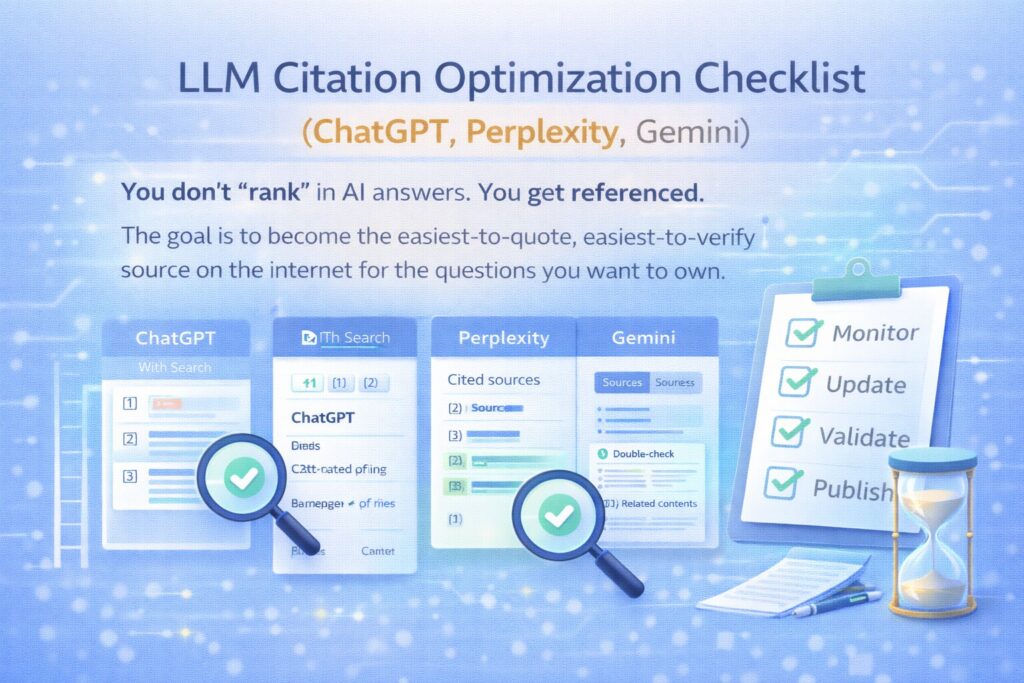
This checklist is designed for:
- ChatGPT (Search + Deep Research)
- Perplexity
- Gemini (Gemini Apps + Google’s ecosystem)
What a citation looks like in each tool?
ChatGPT
When ChatGPT uses Search, it can include inline citations and a Sources panel. Deep Research can produce structured reports with linked sources. [1][2]
Perplexity
Perplexity is citation-forward: answers typically include numbered citations that link to original sources. [3]
Gemini
Gemini Apps can show sources/links for claims, and include a Double-check response feature that uses Google Search to corroborate statements. Gemini responses can also show related content links. [4][5]
The citation ladder (what you’re really optimizing)
Think of citations as a ladder with three rungs:
- Eligibility: Can the platform crawl, index, and access your page?
- Extractability: Can an AI lift a clean, self-contained answer from your page?
- Authority: Is your page a safe, credible choice to cite (and to keep citing)?
If you fail rung #1, nothing else matters.
Master checklist (works across ChatGPT, Perplexity, Gemini)
1) Eligibility: make sure the bots can find you
ChatGPT eligibility (OAI-SearchBot)
OpenAI documents OAI-SearchBot as the crawler used to surface websites in ChatGPT search features. If you block it in robots.txt, your pages may not be shown in ChatGPT Search results. [6]
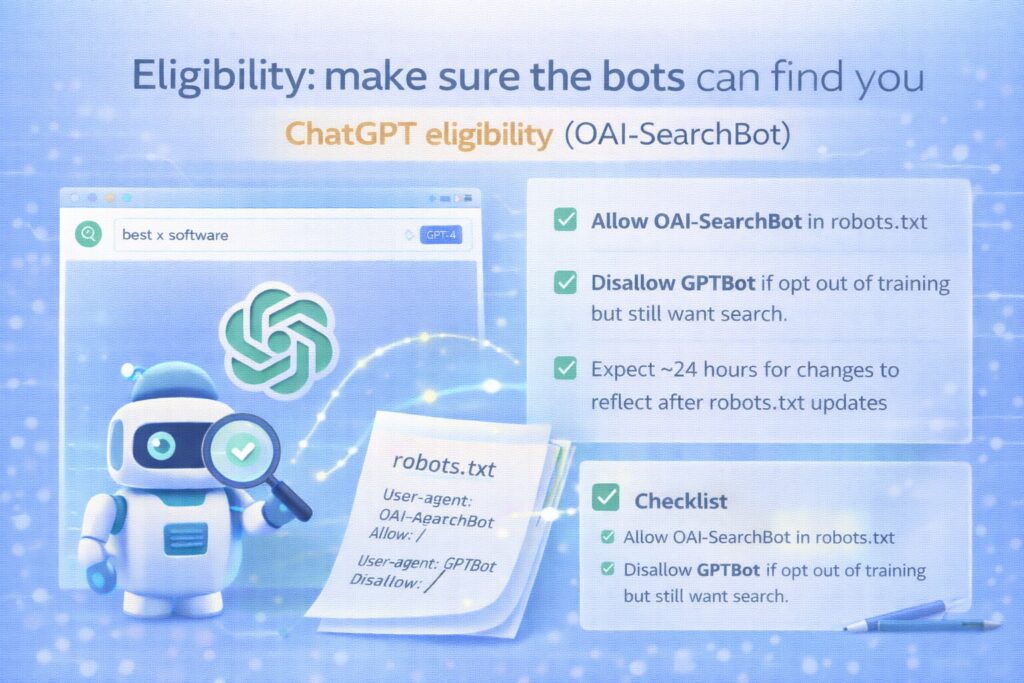
Checklist:
☐ Allow OAI-SearchBot in robots.txt for pages you want cited.
☐ If you don’t want training, you can disallow GPTBot while still allowing search (the controls are independent). [6]
☐ After updating robots.txt, expect up to ~24 hours for changes to reflect. [6]
Example robots.txt pattern:
| User-agent: OAI-SearchBot Allow: / User-agent: GPTBot Disallow: / |
OpenAI also documents ChatGPT-User as a user-initiated fetcher; it is different from search indexing. [6]
Perplexity eligibility (PerplexityBot + WAF reality)
Perplexity documents PerplexityBot as a crawler designed to surface and link websites in its results, and provides guidance for IP allowlisting and robots.txt. [7]
Checklist:
☐ Allow PerplexityBot in robots.txt. [7]
☐ If you use a WAF (Cloudflare/AWS WAF, etc.), whitelist Perplexity’s published IP ranges and verify user-agent. [7]
☐ Expect up to ~24 hours for changes to take effect after updates. [7]
Example robots.txt pattern:
| User-agent: PerplexityBot Allow: / |
Perplexity also documents Perplexity-User for user-triggered fetches, which may behave differently from standard crawling. [7]
Gemini eligibility (Google indexing still matters)
Gemini is closely tied to Google’s indexing ecosystem. If Google can’t crawl/index your pages, you’re playing on hard mode. Google states robots.txt is primarily for crawl management, not for keeping a page out of Search. [8]
Checklist:
☐ Don’t use robots.txt as “security”. It’s not a reliable way to keep pages out of Google Search. [8]
☐ If you must keep a page out of Google, use noindex (meta tag or HTTP header). [9]
☐ Don’t block crawling of a noindex page via robots.txt, or Google may not see the noindex directive. [9]
☐ Use Search Console’s URL Inspection tool to test indexability and request indexing. [10]
2) Extractability: build answer capsules that AI can lift
Most AI citation wins come from a simple pattern: an “answer capsule” placed directly under a question-style heading.
One content audit reported that a strong on-page pattern associated with being cited by ChatGPT was the presence of an answer capsule: concise, self-contained, roughly 20-25 words, placed immediately after a title or question-based H2. The same audit found 72.4% of cited posts had an identifiable answer capsule. [11]
Checklist:
☐ Use question-style titles/H2s (“What is…”, “How do you…”, “Best way to…”).
☐ Immediately follow with a tight capsule that can stand alone.
☐ Keep the capsule clean and link-free; place links below it. [11]
☐ Use scannable structure: short paragraphs, bullets, and subheads.
Answer capsule template (copy/paste):
| What is X? X is ______ that helps ______ by ______. Use it when ______ because ______. |
3) Proof: give the model a reason to cite you (not “anyone”)
Answer capsules get you into the conversation. Original data and owned insight get you cited.
That same audit found that 52.2% of cited posts featured original data or branded-owned insight (for example: benchmarks, surveys, proprietary metrics, study results, or clear methodology). [11]
Checklist:
☐ Add at least one owned element per page (small dataset, benchmark, mini-case study, proprietary framework, or methodology).
☐ Put proof near the answer capsule, not 2,000 words down.
☐ Use plain language around the proof (“In our 2025 analysis of 312 sites…”) so it is easy to lift.
4) Authority: be present where each platform tends to pull from
Different AI platforms cite different types of sources. One analysis of citation patterns (Aug 2024-Jun 2025) reported that ChatGPT frequently cited Wikipedia, while Perplexity and Google AI Overviews leaned heavily on Reddit in that dataset. [12]
Checklist:
☐ Build a consistent entity footprint (brand/name consistency, About page, author bios).
☐ Earn credible mentions in ecosystems that appear frequently in citations (where relevant and appropriate).
☐ Make your page a citation endpoint: the definitive definition, checklist, or benchmark people reference.
For Google AI features, Google says the best practices for SEO still apply and there are no special additional requirements to appear in AI Overviews/AI Mode. [14]
5) Clickability: make the citation attractive after you get it
Being cited is step one. Getting clicked is step two. If your title tag is vague or your meta description is blank, your citation is less likely to earn the click.
Third-party guidance on Perplexity optimization commonly emphasizes strong meta titles and descriptions to improve click-through. [13]
Checklist:
☐ Title tag matches the prompt language (e.g., “LLM citation optimization checklist…”).
☐ Meta description promises the payoff (“Copy/paste checklist + robots.txt patterns…”).
☐ Fast load, minimal popups, and the answer isn’t buried.
6) Measurement: track where you’re getting cited (and why)
Checklist:
☐ Track referral traffic and landing pages (analytics + UTM hygiene).
☐ In ChatGPT, inspect the Sources panel to see what it cited. [1]
☐ In Perplexity, click numbered citations to review source selection. [3]
☐ In Gemini Apps, use Double-check response to see corroboration behavior. [4]
☐ Use Search Console URL Inspection to validate indexability and request indexing. [10]
☐ Watch server logs/WAF events for OAI-SearchBot, GPTBot, PerplexityBot, and Perplexity-User traffic. [6][7]
Platform-specific quick checklists
ChatGPT
☐ Allow OAI-SearchBot (search inclusion). [6]
☐ Add question-based headings + an answer capsule (20-25 words). [11]
☐ Keep the capsule link-free; move links below. [11]
☐ Add original data/owned insight near the top. [11]
☐ Validate via ChatGPT Search sources. [1]
Perplexity
☐ Allow PerplexityBot (search inclusion). [7]
☐ Whitelist Perplexity IP ranges in your WAF if needed. [7]
☐ Structure content for extraction (capsules, bullets, mini-tables).
☐ Tighten title/meta for click-through. [13]
☐ Spot-check by clicking Perplexity citations. [3]
Gemini
☐ Ensure pages are indexable by Google (avoid accidental robots blocks). [8]
☐ Use noindex correctly when needed (and don’t block the page via robots.txt). [9]
☐ Assume classic SEO still matters for AI features. [14]
☐ Use Gemini Apps Double-check response when validating factual answers. [4]
If you only do 3 things this week
- Fix eligibility (OAI-SearchBot + PerplexityBot + Google indexability). [6][7][8]
- Add answer capsules to your top pages (clean, link-free, question-based). [11]
- Add one piece of original data per page (even small benchmarks work). [11]
For developers building citation-first experiences (optional)
If you’re building your own app or workflow, you can often get citations as structured output rather than guessing:
- OpenAI’s web search tooling can return answers with citation metadata (including sources beyond what is cited inline). [15]
- Gemini API supports grounding with Google Search; enabling the google_search tool can produce answers with citations. [16]
Referenceshttps://docs.perplexity.ai/docs/resources/perplexity-crawlers
- OpenAI Help Center – ChatGPT Search.
- OpenAI Help Center – Deep Research FAQ.
- Perplexity Help Center – How does Perplexity work?.
- Google Support – Gemini Apps help (double-check responses, sources, etc.).
- Google Workspace Updates – Related content links in Gemini responses (Sep 2024).
- OpenAI Platform Docs – Bots (OAI-SearchBot, GPTBot, ChatGPT-User).
- Perplexity Docs – Perplexity Crawlers (PerplexityBot, Perplexity-User, IP ranges).
- Google Search Central – Introduction to robots.txt.
- Google Search Central – Block indexing with noindex.
- Google Search Console Help – URL Inspection tool.
- Search Engine Land – How to get cited by ChatGPT (content traits LLMs quote).
- Semrush – Perplexity AI optimization.
- Google Search Central – AI features (AI Overviews/AI Mode).
- OpenAI Developer Docs – Web search tools guide.
- Google AI for Developers – Gemini API: grounding with Google Search.
Related reading (optional)
These are additional context links that were included in the original draft:
- The Verge – Deep Research viewer update (OpenAI)
- The Verge – Cloudflare report on Perplexity bots:
- Reuters – Reddit sues Perplexity over scraping/training (Oct 22, 2025):
- The Verge – NotebookLM can find its own sources:
About The Author