Get Listed Where AI Looks: Roundups, Directories, and the PR Side of Citations
Sometimes the best way to get cited is to stop trying to be the one doing the citing
A lot of brands burn months building “best {category}” pages that will never win.
Meanwhile, the shortlist pages that *do* get cited are already ranking, already trusted, and already structured.
So you play a different game:
Get included.
See Also: What gets cited in ChatGPT / Perplexity for “best {category}” queries?
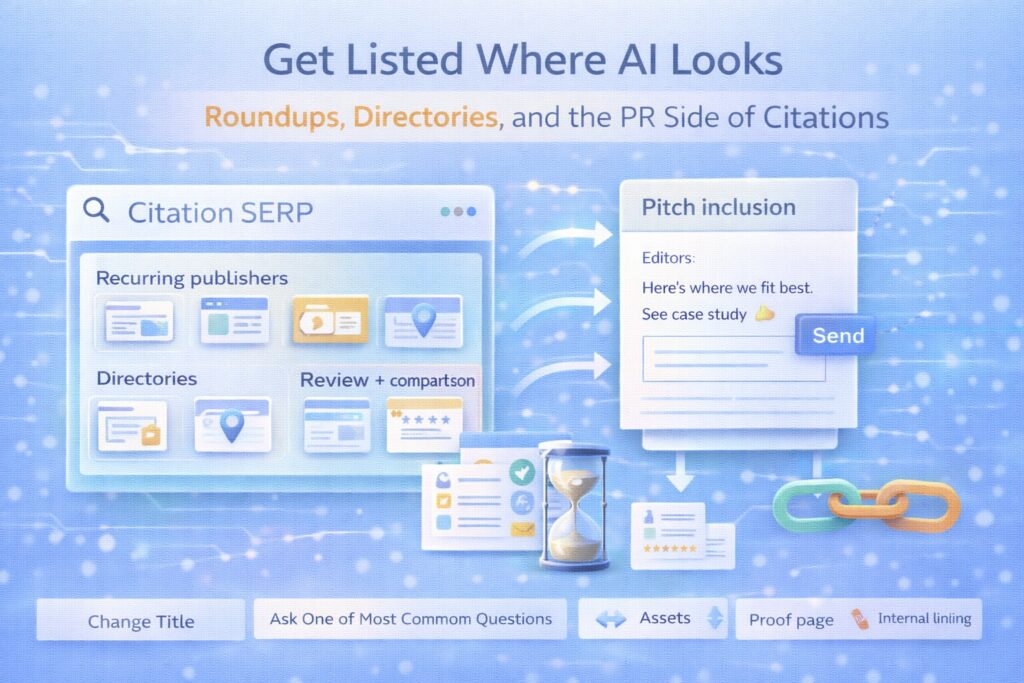
Identify the shortlist gatekeepers (your Citation SERP)
From your citation SERP research, you’ll find:
- recurring publishers
- recurring directories
- recurring ‘review + comparison’ sites
Those are your gatekeepers. Build a target list and work it.
Pitch the inclusion, not the ego
Bad pitch: “We’re the best.”
Good pitch: “Here’s the exact use case where we outperform, plus the constraint where we don’t.”
Editors and reviewers are allergic to hype. They love specificity.
Give them assets that reduce their workload
Provide:
- a one-paragraph ‘best for’ blurb
- 3 bullet differentiators
- 1 honest downside
- screenshots or proof links
- pricing range
Make it easy to include you, and easy to cite you.
See Also: AI Shopping Intent: Structured Data & Reviews
Build your own proof pages to support PR
When you ask to be included, the best follow-up link is rarely your homepage.
It’s a proof page:
- documentation
- methodology
- benchmarks
- case study with constraints
That’s how you turn inclusion into repeatable citations.
Close the loop with internal linking
Once you get included somewhere, link to that roundup from your own cluster.
Then link back to the pillar article to explain the citation ecosystem.
It’s not just vanity. It’s reinforcement.
About The Author