The old game was simple:
Rank a page.
Get the click.
Win the customer.
The new game is… not that.
Because the new “first page” isn’t ten blue links. It’s an AI answer.
And if your brand isn’t in that answer, you’re basically invisible, even if your site is beautiful and your offer is perfect.
So now we have two acronyms that sound like a tie-breaking debate at a marketing conference:
- SEO (Search Engine Optimization)
- GEO (Generative Engine Optimization)
Here’s the punchline:
GEO doesn’t replace SEO. It rides on top of it.
Let’s break this down like we’re building something real.
What SEO is (and still is)?
SEO is still the foundation that makes you eligible to show up.
Search engines need to crawl your site, understand it, index it, and decide it’s useful enough to show.
That part didn’t go away.
If your technical SEO is a mess, GEO won’t save you.
You can’t get cited if you can’t get fetched.
What GEO is (and why it exists)?
GEO is what happens when the search result is not a list, but a generated response.
In generative engines, “visibility” isn’t just ranking. It’s whether you’re cited, where you’re cited, and whether your brand is treated like a source the system trusts.
So GEO is not “rank higher.” It’s “be chosen as the source.”
Why AI search behaves differently than classic search?
Classic search: “here are links.”
AI search: “here is the answer… and here are some links.”
Translation: your content doesn’t just need to match one keyword. It needs to survive a multi-query audition and still look like the best source.
GEO vs SEO in one table (the quick mental model)
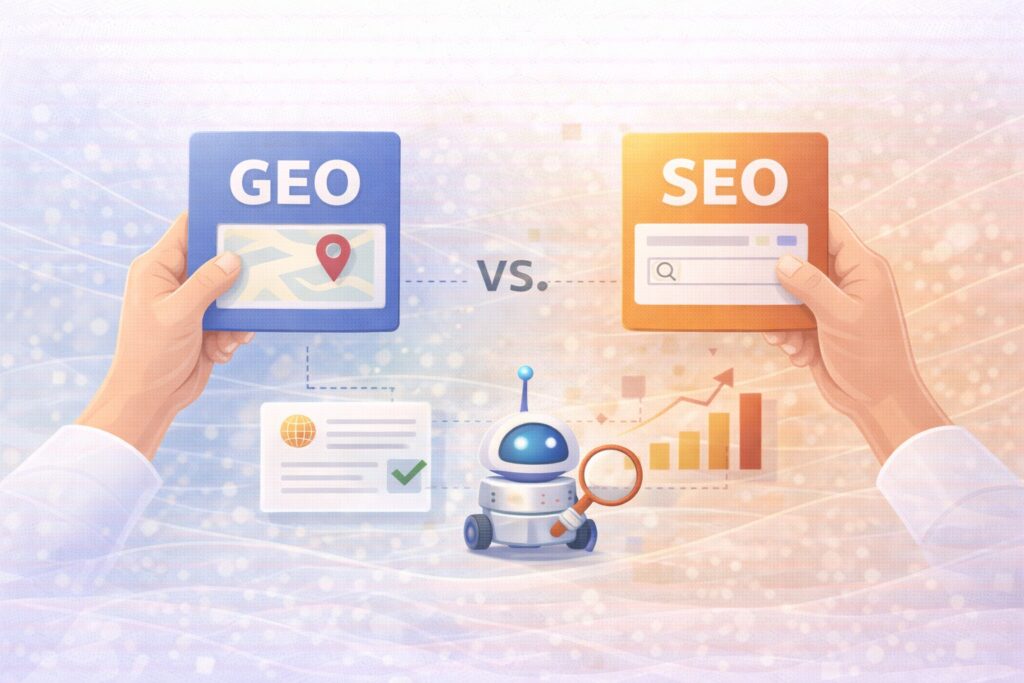
SEO is eligibility. GEO is selection.
- SEO gets you indexed and discoverable.
- GEO gets you cited, quoted, and recommended.
SEO gets you “in the library.” GEO gets you “in the bibliography.”
The biggest differences between SEO and GEO
1) The unit of competition changes
In SEO, the unit is the page. In GEO, the unit is the extract.
AI systems often extract a definition line, a bullet list, a quick comparison block, or a step-by-step sequence.
So if your page is a wall of text with one H2 buried 900 words down… you might rank, but you won’t get cited.
2) The success metric changes
SEO metrics: rankings, clicks, impressions, CTR.
GEO metrics: citations, mentions, “share of answers,” and how often you appear for the questions people actually ask.
Traffic still matters. But the new top-of-funnel win is being referenced inside the answer.
3) “Trust” becomes the main currency
AI systems are trying to avoid hallucinating. That means they prefer sources that look consistent, authoritative, and easy to verify.
Which is why structured data, entity consistency, and off-site mentions matter so much.
Where SEO ends and GEO begins?
Here’s the clean handoff:
SEO makes you machine-accessible
- robots.txt isn’t blocking important pages
- sitemap exists and is clean
- pages are indexable
- structured data helps meaning (when appropriate)
GEO makes you machine-choosable
- your content contains “quote-ready” sections
- your pages include clear definitions and comparisons
- your claims are supported (stats, quotes, references)
- your brand looks like a stable entity across the web
The stacked strategy for 2026: SEO + GEO
If you want the simplest practical playbook, do this:
Step 1: Nail the SEO foundation (don’t skip this)
- Ensure important pages are crawlable
- Maintain a real sitemap (not junk URLs)
- Use structured data where it truly describes visible content
- Fix broken pages, thin pages, and duplicates
Step 2: Convert your content into “citation assets”
This is where most people lose.
Do these upgrades:
- Put a one-sentence definition near the top of the page
- Add a 3–7 bullet “Key Takeaways” block
- Include numbers (benchmarks, ranges, step counts)
- Include quotes (SMEs, customers, partners)
- Link to primary sources where relevant
- Write headings like questions people ask verbatim
Step 3: Build trust signals off-site
In AI search, your website is not “the whole internet.”
AI systems triangulate who you are from reputable mentions, business listings, profiles, associations, and consistent brand information.
Trusted entities win.
The 30-day GEO vs SEO implementation plan
Week 1: Technical cleanup (SEO)
- Crawl the site
- Fix indexation blockers
- Clean sitemap
- Repair internal linking
- Validate structured data
Week 2: “Source of truth” pages (SEO → GEO bridge)
Build or upgrade: About, service pages, FAQ hub, glossary hub. Make them extractable.
Week 3: Cluster content designed for citations (GEO)
Write supporting articles for comparisons, “best for” lists, step-by-step processes, and definitions.
Week 4: Authority + distribution (GEO)
Earn mentions (PR, podcasts, guest features), get cited by trusted sites, and update brand consistency across profiles.
FAQs
Is GEO just a rebrand of SEO?
No. SEO is optimizing to be found and ranked. GEO is optimizing to be used as a source in generative answers. The mechanics and metrics are different.
Does Google require anything special to appear in AI Overviews?
No special “AI-only” setup. You still need to be indexed and have content eligible to be shown and summarized.
What’s the biggest GEO mistake?
Writing content that is “good for humans” but impossible for machines to extract cleanly. Make it quote-ready.
References
AOK Marketing. “How To Get Found In AI Search.” (accessed January 11, 2026).
Google Search Central. “AI features and your website.” (accessed January 11, 2026).
Google Search Central. ” Crawling and Indexing”
Google Search Central.” Introduction to structured data markup in Google Search”
Google Search Central.” Creating helpful, reliable, people-first content”
Google Search Central. ” Google image SEO best practices”
OpenAI. “Introducing ChatGPT search.”
OpenAI. ” ChatGPT generated links:
Perplexity: How does Perplexity follow robots.txt?
ARXIV.ORG” Generative Engine Optimization
About The Author