
How AI Search Pulls Answers (In Plain English) – Query Fan-Out, Citations, and What to Optimize
If you want to win GEO, you need a simple mental model of how AI search works.
Not the technical whitepaper version.
The version you can use to make decisions on Monday morning.

Here it is.
The AI search pipeline (the simple version)
Most generative search experiences follow a pattern like this:
- The user asks a question.
- The system expands it into related sub-questions (this is the fan-out).
- It retrieves information from multiple sources that seem relevant.
- It synthesizes a response.
- It may show citations or supporting links so the user can verify and dig deeper.
Your GEO job is to be one of the sources that survives retrieval and earns citation.
What is “query fan-out” and why should you care?
Fan-out is when one question becomes many questions behind the scenes.
Example: “What is GEO?” can fan out into:
- How is GEO different from SEO?
- How do citations work in AI search?
- What types of pages get cited?
- How do you measure GEO?
- What should a lean team do first?
This is why a single “ultimate guide” is rarely enough. Engines want a web of pages that answer the sub-questions cleanly.
Why extractability beats clever writing?
Engines do not read like humans. They extract like machines.
That is why these formats show up again and again as cited sources:
- Definition-first explainers
- Step-by-step guides
- Clear FAQs
- Buyer-style comparisons with explicit criteria
- Troubleshooting checklists
If your best insight is hidden in paragraph 14, do not be shocked when it does not get cited.
Why corroboration matters? (even when your content is great)
Generative engines are cautious about repeating claims that feel unsupported.
If your page makes a big claim, the system often looks for confirmation elsewhere.
That is why authority work (mentions, profiles, data) is part of GEO, not a separate project.
How to turn this into an optimization plan?
If you want a practical plan, map each part of the pipeline to an action:
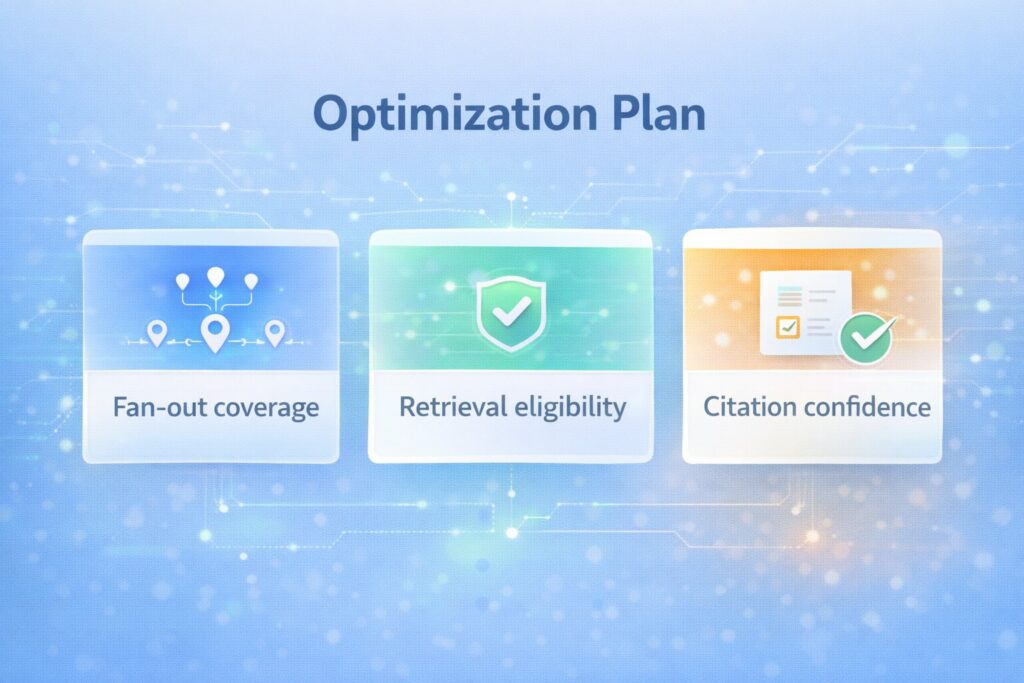
Fan-out coverage
- Build Answer Assets for your top prompts (Cluster 5).
- Organize them into topic clusters and comparisons (Cluster 6).
Retrieval eligibility
- Fix indexability and internal linking (Month 1 work).
- Make your best pages easy to discover within your site.
Citation confidence
- Use definition-first structure and clear headings.
- Add references where it increases trust.
- Keep entity facts consistent so you do not confuse engines.
Where to go next?
If you want the fastest content format for citations, read Cluster 5: the Answer Asset playbook.
If you want to cover fan-out at scale, read Cluster 6: topic clusters and comparison gravity.
And if you want the full program, go back to the pillar: “The Lean In-House GEO Program (6-Month Plan).”
References
- Search Engine Land – “What is generative engine optimization (GEO)?”
- Princeton (KDD 2024) – “GEO: Generative Engine Optimization”
- Google Search Central – “AI features and your website.”
- Google Search Help – “AI Overviews in Google Search”
- Bing Blog – “Introducing Copilot Search in Bing“.
- Perplexity Help Center – “How does Perplexity work?“
- Google Blog – “Generative AI in Search” (May 2024).
About The Author


