The 30-day plan (overview)
This is the simple operating system:
- Week 1: Entity clarity (be unambiguous).
- Week 2: Citable content (be quotable).
- Week 3: Authority (be corroborated).
- Week 4: Technical + measurement (be retrievable and trackable).
If you skip the sequence, you create random improvements with no compounding.
See Also: How to Show Up in ChatGPT: Entity Signals, Content Structure & Citations
Week 1: Entity clarity (Days 1-7)
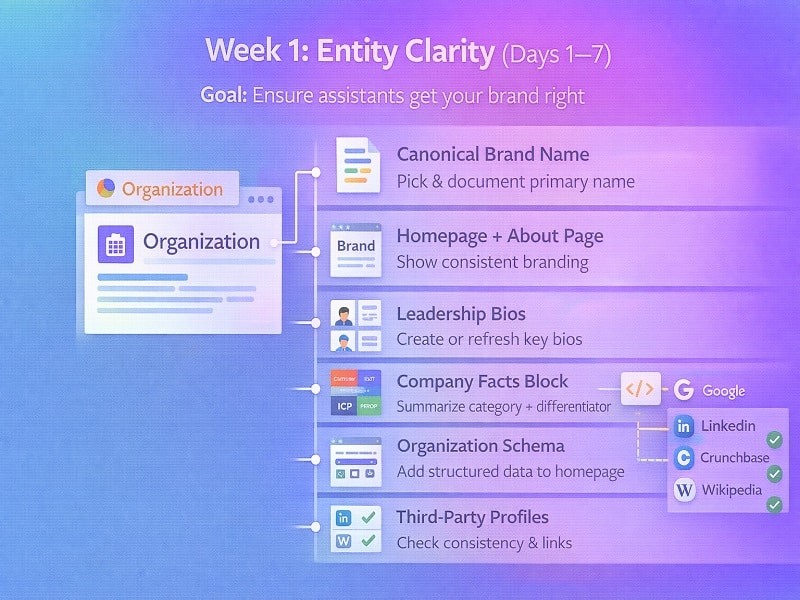
Goal: when someone asks “What is [Brand]?”, the assistant gets the basics right.
- Choose a canonical brand name (and document aliases).
- Update homepage + About page to match that canonical name.
- Create/refresh leadership bios (names, titles, timelines).
- Create a single “company facts” section (category, ICP, differentiator, proof).
- Add Organization schema with sameAs links on the homepage. [1][2]
- Audit major third-party profiles for name + URL consistency.
Week 2: Citable content (Days 8-14)
Goal: publish pages that a model can safely quote without distorting.
- Write an answer-first block for your top 5 money pages (product, service, pricing, comparison, FAQ).
- Add clear definitions with scope (X is Y, in the context of Z).
- Add at least one comparison table (best for / not for / assumptions).
- Add an evidence section that links to primary sources.
- Add dateModified / “last updated” language on pages where facts drift.
- Publish 1 “Brand vs Competitor” page (honest, with constraints).
Reminder: ChatGPT search responses include inline citations. Design your pages to earn those citations. [3]
Week 3: Authority (Days 15-21)
Goal: earn corroboration from independent sources.
- Pitch 5 niche publications with a clean 1-sentence positioning statement.
- Get listed in 3 partner directories (integrations, marketplaces, associations).
- Collect 10 new reviews that include use case + outcome.
- Publish 1 case study that includes measurable results.
- Update your press kit / media page (facts, logos, leadership, contact).
See Also : Authority Layer: PR, Co-Citations, Reviews & Third-Party Validation
Week 4: Technical + measurement (Days 22-30)
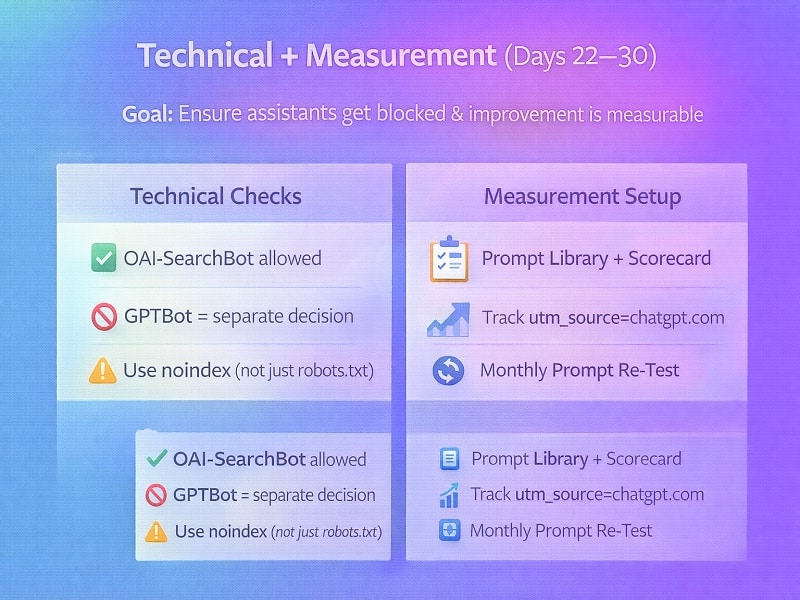
Goal: ensure discovery isn’t blocked and improvement is measurable.
- Verify OAI-SearchBot is not blocked in robots.txt. [4][5]
- Decide your stance on GPTBot (training) separately from search. [4]
- Use noindex properly for pages you don’t want surfaced (don’t rely on robots.txt). [5][6]
- Create a prompt library of 30-50 prompts and run a baseline scorecard.
- Set up analytics tracking for utm_source=chatgpt.com referrals. [7]
- Schedule a monthly re-test: same prompts, same scoring, trend over time.
Done criteria (how you know this worked)
- Your brand is described consistently across your site and key third-party profiles.
- Your core pages have answer-first sections, definitions, comparisons, and evidence links.
- You have fresh third-party mentions and reviews that are specific (not generic praise).
- Your site is crawlable by OAI-SearchBot and you can see referral traffic from chatgpt.com.
- Your prompt scorecard shows improvements in mention + accuracy + citations.
See Also : Technical Layer: Crawlability, Schema & Structured Signals
References
[1] Google Search Central. “Organization structured data.” (accessed Feb 1, 2026).
[2] Schema.org. “sameAs.” (accessed Feb 1, 2026).
[3] OpenAI Help Center. “ChatGPT search.” (Inline citations.) (accessed Feb 1, 2026).
[4] OpenAI API Platform Docs. “Overview of OpenAI Crawlers.” (accessed Feb 1, 2026).
[5] OpenAI Help Center. “Publishers and Developers – FAQ.” (accessed Feb 1, 2026).
[6] Google Search Central. “Block Search indexing with noindex.” (accessed Feb 1, 2026).
[7] OpenAI Help Center. “Publishers and Developers – FAQ.” (accessed Feb 1, 2026).
About The Author