AI tools are everywhere right now, but not all AI models think, write, or reason the same way. To find out how different today’s leading AI tools really compare, we ran a simple experiment: we gave the exact same prompt to three popular AI systems and analyzed their responses side by side.
The goal wasn’t to crown a single “winner,” but to understand how each AI interprets instructions, structures answers, and delivers value—especially for content creation, research, and everyday problem-solving.
Below, you’ll find our setup, the identical prompt we used, and clearly marked sections where you can paste in the results from each AI tool.
The AI Tools We Tested
For this experiment, we tested three widely used AI platforms from major players in the space:
-
ChatGPT by OpenAI
-
Claude by Anthropic
-
Gemini by Google
Each of these tools is trained differently, optimized for different goals, and guided by distinct design philosophies—which makes the comparison especially interesting.
The Exact Prompt We Used
To keep things fair, we used the same prompt word-for-word in all three tools.
Prompt:
“Write one SEO-optimized paragraph targeting the keyword “best AI writing tools.” Keep it clear, natural, and helpful for beginners.”
This prompt was chosen because it tests clarity, creativity, structure, and usefulness—areas where AI responses often diverge.
Results: Side-by-Side AI Responses
Below are the raw responses from each AI. No edits. No cleanup. Just copy-paste outputs so you (and your readers) can judge for yourselves.
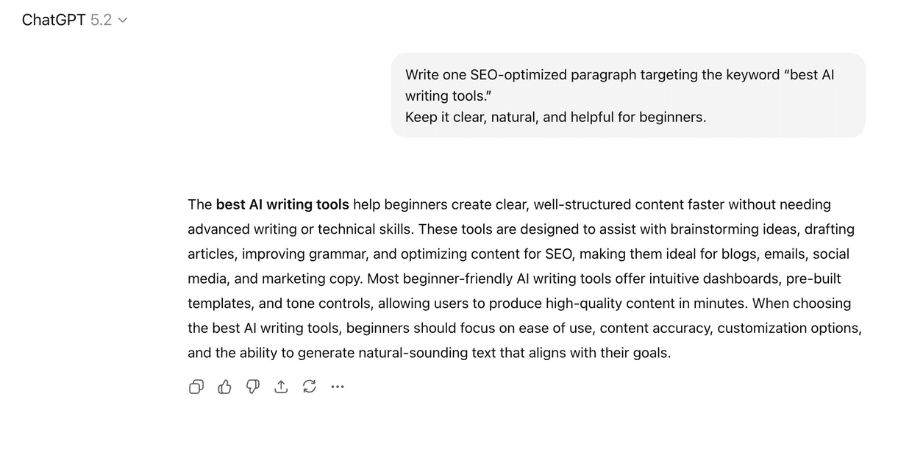
ChatGPT’s Response (OpenAI)
Claude’s Response (Anthropic)
Finding the best AI writing tools can transform how you create content, whether you’re drafting blog posts, marketing copy, or business documents. Today’s leading AI writing assistants like ChatGPT, Claude, Jasper, and Copy.ai offer powerful features that help you overcome writer’s block, generate ideas, and polish your prose in minutes rather than hours. When choosing the best AI writing tool for your needs, consider factors like ease of use, output quality, customization options, and pricing—many platforms offer free tiers perfect for beginners to explore. These tools work by using advanced language models to understand your prompts and generate human-like text, making them invaluable for content creators, marketers, students, and professionals who want to write faster without sacrificing quality. The best approach is to test a few options yourself, as the “best” tool ultimately depends on your specific writing goals, budget, and preferred workflow.

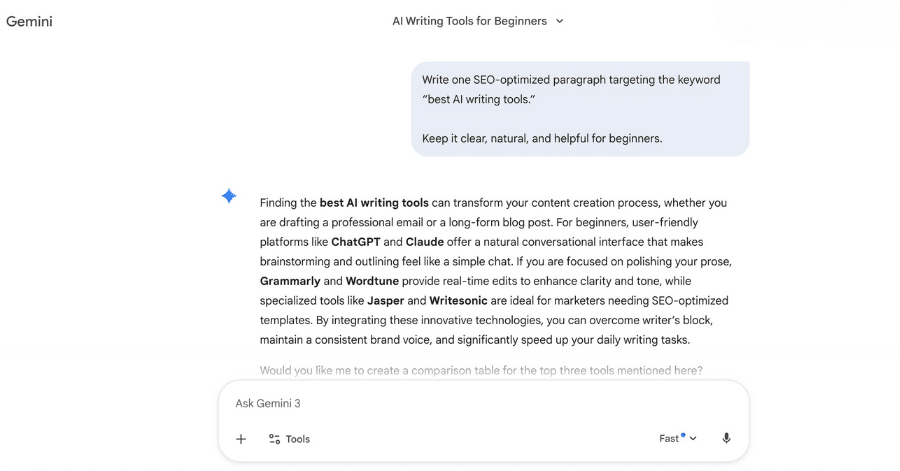
Gemini’s Response (Google)
Finding the best AI writing tools can transform your content creation process, whether you are drafting a professional email or a long-form blog post. For beginners, user-friendly platforms like ChatGPT and Claude offer a natural conversational interface that makes brainstorming and outlining feel like a simple chat. If you are focused on polishing your prose, Grammarly and Wordtune provide real-time edits to enhance clarity and tone, while specialized tools like Jasper and Writesonic are ideal for marketers needing SEO-optimized templates. By integrating these innovative technologies, you can overcome writer’s block, maintain a consistent brand voice, and significantly speed up your daily writing tasks.
Why This Comparison Matters
If you’re a:
-
Content creator deciding which AI fits your workflow
-
Marketer testing AI for blogs, ads, or SEO
-
Founder or operator evaluating productivity tools
…then understanding how different AI tools respond to the same input can save time, money, and frustration.
The “best” AI often depends less on hype—and more on how it thinks.
Final Thoughts
This experiment highlights an important truth: AI isn’t one-size-fits-all. Even with identical prompts, outputs can vary dramatically in tone, clarity, creativity, and usefulness.
Once you paste in the responses above, your readers can see the differences for themselves—and decide which AI works best for their needs.
About The Author