It’s 2026.
Your customer’s first “sales call” often isn’t your website.
It’s an AI answer.
And that AI answer is increasingly built from summaries + citations + stitched-together sources, not just the ten blue links we grew up with.

So here’s the uncomfortable question:
When someone asks the question that makes you money… whose answer shows up?
If it’s not yours, it’s someone else’s.
And in a lot of categories, the most “human” answers on the internet live in exactly two places:
Reddit and Quora.
Not because they’re perfect.
But because they’re full of real problems, real context, real caveats, and real opinions.
Which is exactly what AI systems love to summarize.
The shift: you’re not optimizing for clicks anymore
Google’s AI experiences (AI Overviews and AI Mode) are explicitly framed as AI snapshots with links to dig deeper, designed to help people get the gist faster.
Google also describes AI Mode and AI Overviews as using a “query fan-out” approach, which means issuing multiple related searches across subtopics and data sources to build a response, then showing a broader set of supporting links than classic search.
Now add the behavioral reality:
A Pew Research Center analysis of Google searches (March 2025 browsing data) found that when an AI summary appears, users click traditional search results less often (8% vs 15% when there is no AI summary), and they “very rarely” click the sources cited in the summary (about 1% of visits).
Translation:
You can “win” visibility without winning traffic.
And that’s the whole point of this article.
Because this is the new game:
- You don’t just want to rank.
- You want to be referenced.
- You want to be the source the model feels safe summarizing.
Why Reddit and Quora are showing up in the AI source layer?
This isn’t a conspiracy. It’s economics.
Reddit’s content has become valuable enough that major AI players are cutting deals to access it as structured, real-time data.
- OpenAI announced a partnership to access Reddit’s Data API and “bring enhanced Reddit content” into ChatGPT and new products.
- Google announced expanded access to Reddit’s Data API to better understand and “display, train on, and otherwise use” Reddit content.
- Reuters reported the Google–Reddit licensing deal was worth about $60M/year (per sources familiar with the matter).
Quora is showing up too especially in Google’s AI experiences.
Semrush analyzed 26,000 Quora URLs cited in Google AI Mode and reported that Quora links appeared in 7.25% of responses (“about 1 in 14”), with engagement and Quora’s “Most Relevant” labeling correlating with being cited. (That’s Semrush’s dataset and interpretation, not a Google guarantee but it’s a useful directional signal.)
So the strategic takeaway is simple:
If models and AI search experiences are pulling from community Q&A, your best “AI SEO” might be answering questions like a human.
Enter the “money question”
Your money question is the question someone asks right before they’re willing to spend.
It’s not your vanity keyword.
l It’s not “what is ____”.
- “Is ____ worth it?”
- “What’s the best ____ for my situation?”
- “Should I hire someone or DIY?”
- “How much does ____ cost in 2026?”
- “What mistakes should I avoid when buying ____?”
- “____ vs ____: which is better for a small team?”
These questions are conversion-shaped.
And increasingly, people ask them inside AI, or they ask Google and get an AI summary that “answers” them without a click.
Now here’s the play:
You draft helpful, nonpromotional Reddit/Quora answers that align to your money question.
Not to spam.
Not to “seed” fake narratives.
To create a credible public reference that:
- actually helps a human, and
- gives AI systems something safe and structured to summarize.
Google’s own guidance on succeeding in AI Search experiences is basically: make unique, satisfying content for people.
Same principle. Different distribution channel.
Why nonpromotional wins (and “promo” loses)?
Because both platforms are explicitly allergic to it.
Quora’s platform policies define spam to include posting irrelevant answers or excessively promoting products/services “for the purpose of driving traffic to an external site or for monetary gain,” and they call out coordinated inauthentic activity (like vote manipulation).
Reddit’s help docs define spam as repeated/unsolicited actions for exposure or financial gain, and explicitly warn about mass-posting repetitive content and using tools (including generative AI tools) that facilitate spam.
Even Reddiquette’s old-school rule of thumb is blunt: link to your own stuff “within reason,” but if that’s all you ever do, you “might be a spammer.” It cites a widely used 9:1 guideline.
So here’s the irony:
The best way to “market” on Reddit/Quora is to not market.
Or more accurately:
- Market by being useful
- Sell later, somewhere else
- Let your profile and your consistency do the “branding” work
- Let the answer stand alone
This is exactly the kind of content that survives moderation, gets upvoted, and becomes reference material.
The real goal: become a “verifiable entity,” not a loud brand
One of the most important ideas in AI-era visibility is this:
AI doesn’t recommend brands. AI recommends entities it can verify.
That verification comes from repetition, consistency, and trusted references across the web.
Reddit/Quora answers aren’t magic.
But they are public, indexable discussions (often with long dwell time, engagement signals, and real-world context).
They can contribute to the “entity footprint” that helps machines understand:
- who you are
- what you do
- what you’re known for
- what you’re not
And you don’t accomplish that with a link drop.
You accomplish it by writing the kind of answer that feels like:
“This person has done this before.”
The playbook: write answers that AI can reference and humans want to read
Here’s a simple 7-step workflow you can run every week.
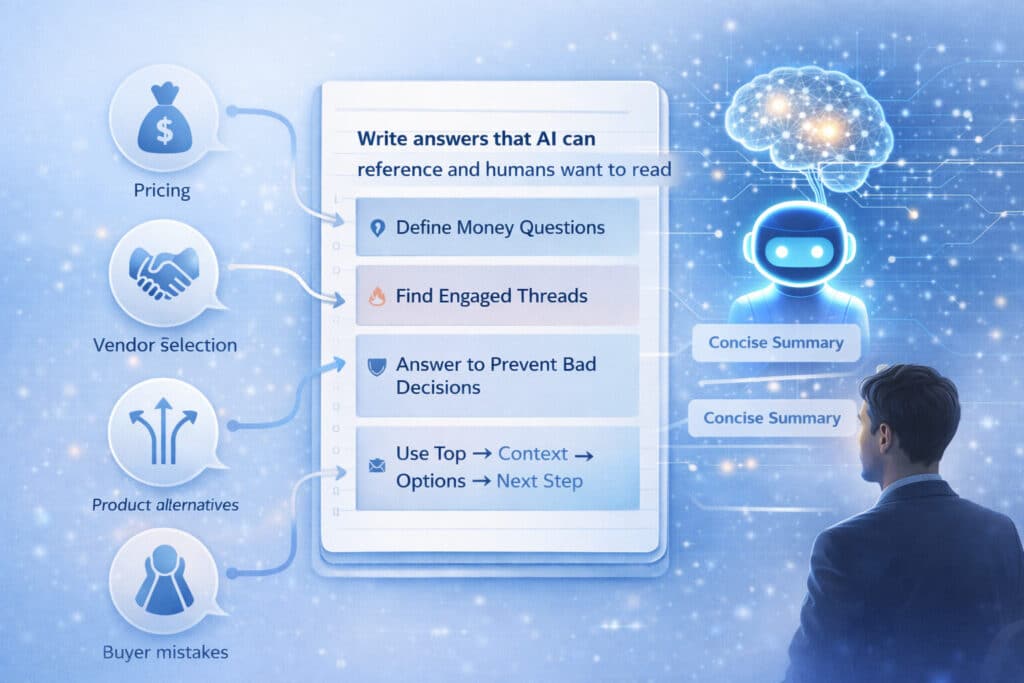
1) Define 10–25 money questions
Pick the questions that show intent.
If you sell a service, include:
- pricing expectations
- timelines
- what to look for in a vendor
- common failure modes
- “DIY vs hire” comparisons
If you sell a product, include:
- alternatives
- setup complexity
- who it’s for / not for
- total cost of ownership
- buyer mistakes
2) Pick the questions that already have heat
You want threads that are:
- already getting views
- already getting replies
- clearly framed (not vague ranting)
- not purely hypothetical
Why?
Because those threads are more likely to be surfaced, linked, and re-used as references. (Semrush’s Quora analysis specifically points to engagement as a strong correlating signal.)
3) Answer like you’re trying to prevent a bad decision
This is the mentality shift.
Don’t answer like a marketer.
Answer like a senior person who has watched people get this wrong 100 times.
4) Use the “Top → Context → Options → Next step” structure
This format is boring.
That’s why it works.
Top (2–3 sentences): the direct answer.
Context: what matters, what changes the answer.
Options: 2–4 paths with tradeoffs.
Next step: a small, practical action they can take today.
This structure is also model-friendly because it’s easy to summarize cleanly without losing the point.
5) Make it citeable
If you want AI systems to safely reuse your content, you need to reduce ambiguity.
Tactics that help:
- Define terms (don’t assume jargon)
- Use numbers when appropriate (ranges, thresholds, timelines)
- Use bullet lists and “if/then” logic
- Include caveats for edge cases (“If you’re in X situation, the advice changes.”)
Google’s own documentation says AI Overviews are designed to surface information that’s supported by high-quality web results and include links to supporting web content.
Your job is to write something that deserves to be supporting content.
6) Keep it nonpromotional by design
A clean rule:
If you removed your name and profile, would the answer still be useful?
If yes, you’re safe.
If no, you’re advertising.
And don’t play games with “soft promotion” tactics that trigger spam filters:
- repetitive phrasing across multiple answers
- link stuffing
- copy/paste templates
- “DM me for details” everywhere
These look like patterns. Patterns get flagged.
7) Be consistent, not loud
One great answer per day for 30 days beats 10 mediocre answers in one weekend.
Not because of “the algorithm.”
Because the internet (and AI systems) trust patterns over time.
A practical answer template you can use today
Here’s a plug-and-play outline that stays nonpromotional:
- Direct answer: “If you want X outcome and you have Y constraint, you should do A. If you have Z constraint, do B instead.”
- Why people get it wrong: list 2–3 common mistakes.
- Decision checklist: 5 bullets.
- Cost / time reality check: give ranges and what drives them.
- What I’d do if I were you: one simple next step (not “buy my thing”).
That’s it.
No links required.
No pitch required.
Just competence.
What not to do (if you like your account)
This matters because the whole strategy collapses if you get flagged, downranked, or banned.
Avoid:
- mass-posting repetitive content “for exposure or financial gain”
- coordinated voting / inauthentic engagement
- turning every answer into an external traffic funnel
- using automation in a way that looks like spam (especially at scale)
Also avoid the strategic trap:
Don’t try to “game” AI.
Write for the human. Let the model do what it does.
Even Google’s messaging for AI search experiences keeps coming back to the same point: focus on helpful, people-first, unique content.
What to do now?
If you want a concrete action plan, do this:
- Write down 10 money questions your best customers ask.
- Find 3 threads per question on Reddit/Quora where people are already discussing it.
- Write one genuinely helpful answer per day for 14 days using the structure above.
- Track what happens:
- Are you getting upvotes?
- Are people replying?
- Are you being followed?
- Are you getting profile clicks (without forcing them)?
This is not “viral marketing.”
This is public expertise.
And in an AI world built on stitched summaries and citations, public expertise is an asset.
About The Author